On being invited to write about storylines, extreme rainfall, and why this matters to me.
A few months ago, I received an email that made me pause for a moment.
I was invited to write a News & Views in Nature Communications on a paper attributing the 2024 Valencia flash floods — a complex, convective extreme rainfall event analysed using a conditional (storyline-based) approach that I had recently reviewed.
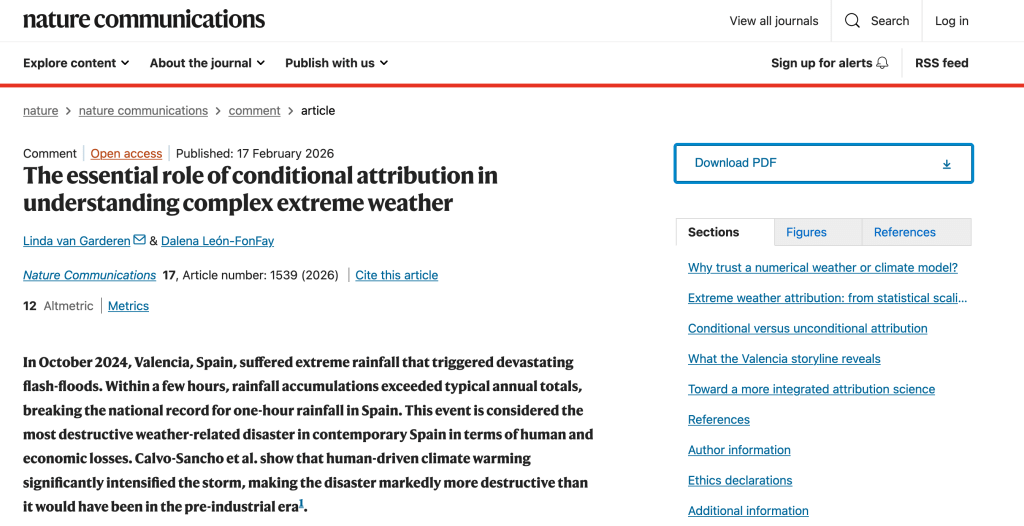
It felt like a real honour to contribute, and I wrote a piece titled “The essential role of conditional attribution in understanding complex extreme weather“.
Storylines — and more broadly, the question of how we understand climate change in extreme weather events — have been close to my scientific heart for a long time. The debate about statistical versus conditional attribution, about probabilities versus processes, about dynamics versus thermodynamics — these aren’t abstract academic discussions to me. They are questions that shape how we translate climate science into something meaningful for society.
Flash floods caused by convective storms are among the most difficult events to attribute. They are small-scale, highly dynamic and often chaotic. Exactly the kind of extremes that push our models — and our methods — to their limits.
The study by Calvo-Sancho and colleagues shows that even in these highly complex systems, a clear climate-change signal can be uncovered when we carefully reconstruct and analyse the physical processes within the storm. It demonstrates that attribution is not just about saying whether an event became “more likely,” but also about understanding how global warming reshapes the physical processes within the extreme event itself.
For me, writing this piece was not just about explaining a method. It was about reflecting on where attribution science is heading — and on the questions that are currently being discussed within the community.
How do we best combine statistical and conditional approaches?
How do we move from understanding probabilities to understanding processes?
And perhaps most importantly: how do we meaningfully connect attribution results to impact research?
These are active conversations within the attribution community. My task was to translate that debate in a way that readers outside the field could follow and understand.
Being invited to contribute to that conversation — even in a small way — was an honour. It reminded me why I care about this topic: because understanding extreme weather is not only about getting the science right, but about making that science useful for all of us.
 Linda van Garderen