
Welcome
I’m Linda, a climate scientist dedicated to making sense of extreme weather and our changing climate.
Here you’ll find my professional work, research, teaching, and ongoing projects — all rooted in a commitment to clear, evidence-based science.
I share insights, articles, and explainers that break down complex climate topics into accessible, engaging stories for anyone who wants to understand what’s happening to our planet — and why it matters.
Explore, read, and discover how my work connects science with real-world action.




Latest Blog Post:
- Behind the article on the Dutch Tulip Fund
Sometimes an opinion piece is carefully planned. This was not one of those times; it was written in the moment when the need for another perspective became immediately clear.
The opinion piece article was written in response to Dutch news coverage celebrating the Tulip Fund, a €50 million initiative that has already attracted several researchers from the United States to the Netherlands. While the media highlighted the success of the programme and the importance of supporting colleagues whose academic freedom is under pressure, both Swinda Falkena and I immediately felt that an important part of the story was missing—a part we had been discussing since the fund was actively considered by our own university.
We argue that while attracting international talent is valuable, the Tulip Fund risks reinforcing existing inequalities within Dutch academia. By focusing substantial resources on recruiting researchers from abroad, the programme overlooks the structural challenges faced by early-career researchers already working in the Netherlands, such as job insecurity, limited funding opportunities, and a lack of long-term prospects.
What started as a short WhatsApp conversation quickly turned into something much bigger. During her lunch break, Swinda began writing down her thoughts. Throughout the afternoon, we exchanged drafts, refined the wording, and carefully balanced criticism with nuance. We wanted to make one thing absolutely clear: this was never an argument against supporting researchers from abroad. Rather, we wanted to show how the Tulip Fund is part of a much deeper structural problem in Dutch academia—one that has affected early-career researchers for years.
By the end of the day, Swinda submitted the article to de Volkskrant. The following day, it was published. If only academic publishing could be that efficient, we joked afterwards.

Screenshot of our article as published in Volkskrant (8 July 2026) - When the Topic Comes Back to You
On being invited to write about storylines, extreme rainfall, and why this matters to me.
A few months ago, I received an email that made me pause for a moment.
I was invited to write a News & Views in Nature Communications on a paper attributing the 2024 Valencia flash floods — a complex, convective extreme rainfall event analysed using a conditional (storyline-based) approach that I had recently reviewed.
It felt like a real honour to contribute, and I wrote a piece titled “The essential role of conditional attribution in understanding complex extreme weather“.
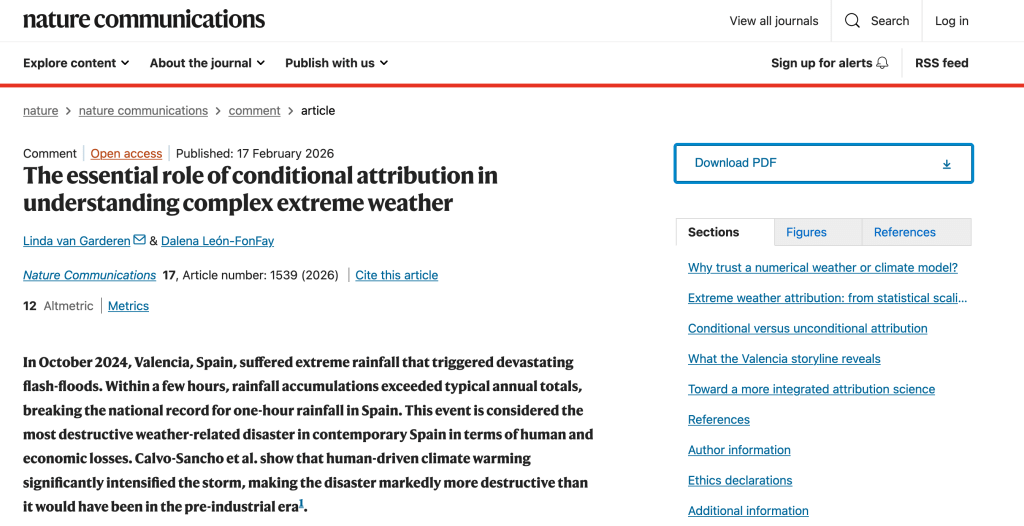
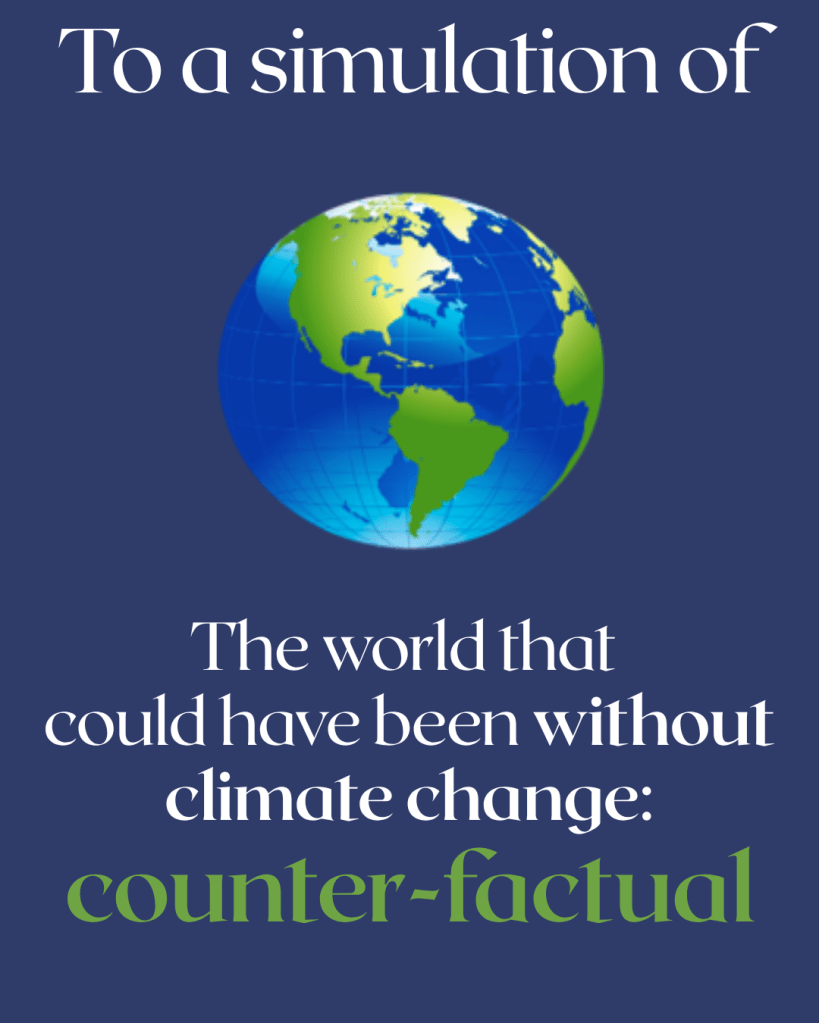
Nature Communications News & Views accompanying Calvo-Sancho et al. on the attribution of the 2024 Valencia flash floods. For the full article click here. Storylines — and more broadly, the question of how we understand climate change in extreme weather events — have been close to my scientific heart for a long time. The debate about statistical versus conditional attribution, about probabilities versus processes, about dynamics versus thermodynamics — these aren’t abstract academic discussions to me. They are questions that shape how we translate climate science into something meaningful for society.
Flash floods caused by convective storms are among the most difficult events to attribute. They are small-scale, highly dynamic and often chaotic. Exactly the kind of extremes that push our models — and our methods — to their limits.
The study by Calvo-Sancho and colleagues shows that even in these highly complex systems, a clear climate-change signal can be uncovered when we carefully reconstruct and analyse the physical processes within the storm. It demonstrates that attribution is not just about saying whether an event became “more likely,” but also about understanding how global warming reshapes the physical processes within the extreme event itself.
For me, writing this piece was not just about explaining a method. It was about reflecting on where attribution science is heading — and on the questions that are currently being discussed within the community.
How do we best combine statistical and conditional approaches?
How do we move from understanding probabilities to understanding processes?
And perhaps most importantly: how do we meaningfully connect attribution results to impact research?These are active conversations within the attribution community. My task was to translate that debate in a way that readers outside the field could follow and understand.
Being invited to contribute to that conversation — even in a small way — was an honour. It reminded me why I care about this topic: because understanding extreme weather is not only about getting the science right, but about making that science useful for all of us.
- Tipping Point of AMOC Expected in 2060: New Study Shows
A new study led by my colleague René van Westen investigates the future of the Atlantic Meridional Overturning Circulation (AMOC) — the great conveyor belt of ocean currents that moves warm water northward and returns colder, denser water southward at depth. This circulation plays a crucial role in regulating Earth’s climate, including weather patterns in Europe and Africa, the strength of monsoons, and sea level along the Atlantic coasts.
Why is AMOC important?
The AMOC transports heat from the tropics towards the north. This means the current redistributes heat, keeping northern Europe relatively mild compared to other regions at the same latitude, such as western Canada.
We already know from observations that the AMOC has been slowing down. A collapse would cause heat to remain where it is instead of spreading across a larger region. This would lead to: a colder climate in northwestern Europe, stronger storms in some regions, drought in others, and disruptions to ecosystems on land and in the ocean.
A weakening or collapse of AMOC would not raise sea levels evenly everywhere. Instead, it would cause increased sea level across the northern regions of the Atlantic, especially along the U.S. East Coast and parts of northwestern Europe.
What does the new study show?
Using climate model simulations and statistical indicators of stability (early warning signals of approaching tipping points), the researchers estimate when AMOC might cross a critical threshold. Their results suggest that under continued greenhouse gas emissions, the tipping point could be reached as early as 2060.
In their analysis, the collapse happens after around 2.5 °C of global warming. That means AMOC breaking is not inevitable — if we reduce emissions and limit warming, we can prevent crossing this threshold.
Crossing the tipping point would mean that the AMOC circulation weakens beyond recovery. In other words:
➡️ It cannot be fixed once passed.
➡️ Crossing the tipping point is permanent.Public attention in the Netherlands
The research received wide attention here in the Netherlands. My colleague René was interviewed by the national news program Nieuwsuur 📺. The AMOC story runs from 28:45 to 34:42 in the episode of 26 August 2025, which you can watch here (in Dutch):
👉 Nieuwsuur episodeFor those who want to dive into the science itself, the peer-reviewed article is available open access:
👉 Geophysical Research Letters (2025)Why it matters
This study highlights how tipping points in the Earth system are not distant possibilities, but real risks that may occur within our lifetimes. The precise timing is uncertain — but the message is clear: limiting warming below 2.5 °C keeps the AMOC safe. Acting now gives us the chance to prevent a permanent and dramatic shift in our climate system.

