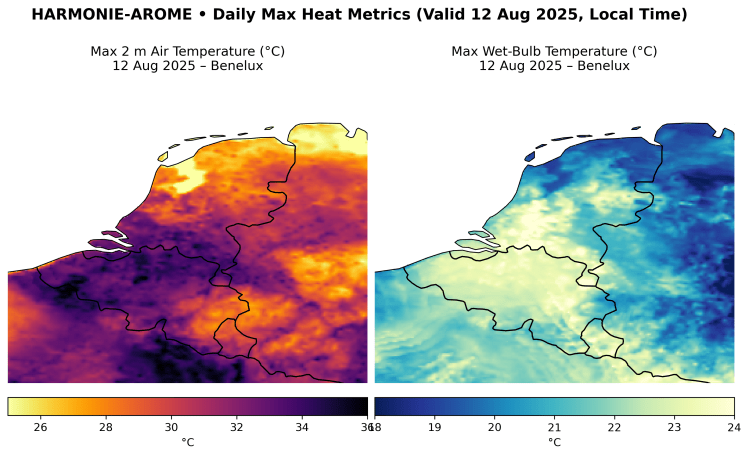
Above you see the predictions for tomorrow: on the left the maximum temperature, and on the right the maximum wet-bulb temperature. The latter is very interesting, because it shows whether we might experience the day as simply warm or as muggy. The higher the wet-bulb temperature, the more humid it feels and the harder it becomes to evaporate sweat—yes, that sounds a bit disgusting, but it’s a life-saving mechanism our body relies on to maintain a proper core temperature.
A temperature of 33 °C with a wet-bulb temperature of 24 °C means it will be very muggy, which increases the risk of heat stress. A brief overview of how to interpret wet-bulb temperature is below:
| WBT (°C) | How it may feel | Practical guidance | Sources |
|---|---|---|---|
| ≤ 18 | Comfortable; air feels fresh. Evaporative cooling works well. | Normal activity for most people. | [S1] |
| 18–21 | Humid; starts to feel sticky, especially at night. | Hydrate; ventilate indoor spaces. | [S1] |
| 21–24 | Muggy. Strenuous activity feels taxing. | Plan shade/rest; increase fluids. | [S1][S4] |
| 24–26 | Very muggy; heat stress risk rising. | Limit hard work; schedule breaks; check on vulnerable people. | [S4] |
| 26–28 | Dangerous for heavy exertion. | Frequent rests; active cooling; consider moving activities indoors. | [S4][S5] |
| 28–30 | High risk; even light activity can feel oppressive. | Short exposures only; monitor symptoms closely. | [S4][S5] |
| 30–32 | Very high risk. Lab studies show limits near ~31 °C for young, healthy adults under light activity. | Strong precautions; seek cool, conditioned spaces. | [S5] |
| ≥ 32–35 | Critical zone. Approaches theoretical survivability limit (~35 °C). | Continuous exposure unsafe; emergency cooling required. | [S3][S4] |
Notes: WBT blends heat and humidity into one number (not the same as WBGT). Sun, wind, clothing, and activity can raise risk at any WBT. Ranges above are practitioner-oriented guidance, not medical standards.
Sources: [S1] AMS Glossary: Wet-bulb temperature. [S2] Stull (2011) JAMC: Wet-bulb from T & RH. [S3] Sherwood & Huber (2010) PNAS: ~35 °C limit. [S4] Raymond et al. (2020) Science Advances: severe impacts well below 35 °C. [S5] Penn State HEAT studies: limits often ~31 °C WBT.
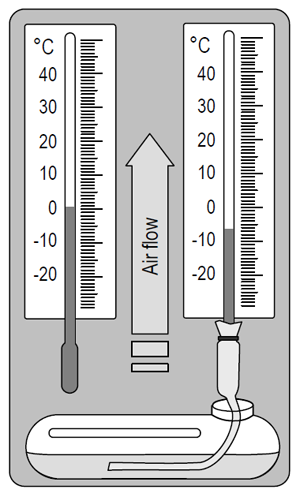
So how does it work, and what does wet-bulb temperature actually mean? Well, in practice it is literally that: a thermometer kept wet (see the image below). What that does is measure the temperature in saturated air. If there’s little humidity in the air, the wet-bulb temperature will be much lower than the air temperature. If it’s humid, though, the two temperatures will be much closer together.
 Linda van Garderen